
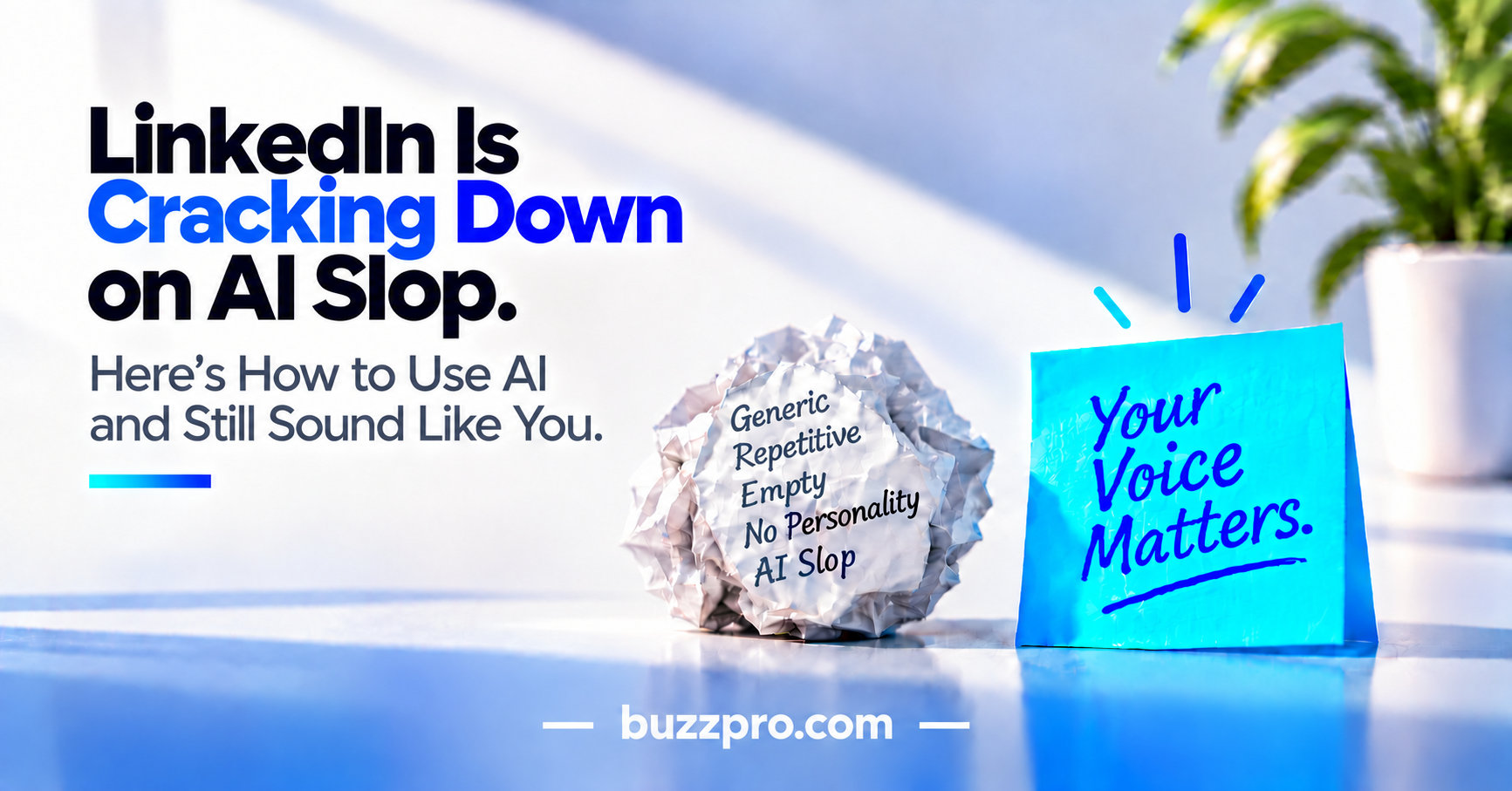
LinkedIn® has a message for all of us: People want to hear from real people, not a flood of generic AI-generated content. And LinkedIn members seem to agree.
In September 2026, LinkedIn reported that more than 1 million members had used its new “Seems Like AI Slop” option since it launched in August. LinkedIn also says its recent efforts have reduced views of content it classifies as AI slop by 40% (LinkedIn Pressroom).
So, does this mean you shouldn’t use AI to help create your LinkedIn content?
No.
In fact, LinkedIn says it’s okay to use AI to help you write. The key is making sure your posts and comments still represent your voice and your perspective (LinkedIn Pressroom).
That’s an important distinction. AI can be a helpful tool for researching, brainstorming, organizing your thoughts, and improving your writing. But it shouldn’t replace your ideas, experience, expertise, or personality.
People don’t build relationships with AI. They build relationships with people. And that’s what Social Selling has always been about.
What Does LinkedIn Mean by “AI Slop”?
So, what exactly is “AI slop”?
LinkedIn describes it as low-effort, likely AI-generated content that may sound polished but doesn’t really say much (LinkedIn Pressroom). It can be generic, repetitive, or recycled. It may lack a clear point of view or personal experience, or be written mainly to grab attention instead of adding something useful to the conversation.
Notice that polish isn’t the issue, and neither is AI. The problem is when AI becomes the content.
Think about a leadership post filled with phrases like “Great leaders inspire others,” “Success starts with mindset,” or “Leadership is about empowering your team.” There’s nothing necessarily wrong with those ideas. But you’ve probably seen them a hundred times, and they could have been written by almost anyone.
Now imagine that same post includes a lesson you learned managing a team, a mistake you made, a conversation with an employee, or something that changed the way you think about leadership. It may be a little less polished, but it’s real, it’s useful, and it sounds like you.
Now it’s your content. And that’s the kind of post that starts conversations.
LinkedIn says it wants to be a place for “real people, real expertise, and real perspectives” (LinkedIn Pressroom). I think that’s a pretty good standard for all of us.
AI can help you communicate your ideas. But you still need to give people something only you can bring to the conversation.
LinkedIn Isn’t Saying “Don’t Use AI”
Here’s the important part: LinkedIn is fine with us using AI. What it’s changing is how AI helps us communicate.
LinkedIn is replacing its “enhance your post” feature with tools designed to proofread your writing and improve clarity without changing your voice (LinkedIn Pressroom). Its new Post Proofreader, available to Premium members, shows suggested changes so you can review each one and decide whether to use it (Social Media Today).
That tells us a lot. LinkedIn is comfortable with AI helping you say what you mean. What it doesn’t want is AI deciding what you mean for you.
I use AI in my own BuzzPro® content, too. I use ChatGPT for research, brainstorming ideas, and creating my banner images. Then I write almost all of my copy with Claude, my main writing partner. And I always make the final call.
But I don’t want AI deciding what I think or what I want to say. I want it to help me communicate my ideas, my experience, and my point of view more clearly.
That’s how I think we should all look at AI. Use it as a tool, not as a replacement for you.
The goal is to sound like you, only clearer.
Why Your Own Voice Matters More Than Ever
It’s easy to think about all of this in terms of the LinkedIn algorithm. Will my post get fewer views? Will LinkedIn flag my content?
But there’s a bigger reason your voice matters, and it has nothing to do with the algorithm.
Your content is part of your professional brand. Every post and comment tells people a little more about who you are, what you do, and how you can help. Your experiences, opinions, lessons learned, and personal stories are what give your content personality. They’re also what help people get to know you and understand what you bring to the table.
That’s especially important on LinkedIn® because we’re not just sharing content. We’re building relationships.
The same is true when you comment on someone else’s post. A thoughtful comment can start a conversation. That conversation can lead to a new connection, and over time, that connection can become a valuable relationship. That’s why I believe your comments should sound like you, too.
Social Selling isn’t about selling first. It’s about helping first, building trust, and creating relationships. The goal is to take those online conversations offline with a phone call, a Zoom meeting, or a face-to-face conversation. Nothing happens until you have a conversation with someone.
AI can help us along the way. But the more AI-generated content we see, the more valuable our own experiences, ideas, and voices become.
You don’t need to sound perfect. You need to sound like you.
People don’t build relationships with AI. They build relationships with people.
Five Ways to Use AI Without Losing Your Voice
So how do you use AI and still sound like you? Here are five simple ways to put it to work.
1. Start with your own idea and experience.
Before you ask AI to help, give it something from you. Jot down what you think, what you’ve learned, what you’ve experienced, or what you want people to understand. The more of yourself you put in at the beginning, the more the finished content will sound like you.
2. Use AI to help, not replace, your thinking.
AI is great for research, brainstorming, organizing ideas, and making your writing clearer. But you should still decide what you believe, what matters, and what you want to say. If AI suggests a point you don’t actually agree with, leave it out.
3. Keep your comments your own.
Comments are conversations. A short, genuine comment written in your own words can do more to build a relationship than a polished comment that sounds automated. If you’re trying to build relationships on LinkedIn®, let people hear from you.
4. Read everything before you post it.
Don’t simply copy and paste what AI gives you. Read it carefully, or better yet, read it out loud. Ask yourself, “Would I actually say this?” If the answer is no, change it.
5. Make the final version yours.
Remove anything that sounds generic, overly polished, or unlike you. Add your own words, a specific example, your opinion, and your personality.
Before you publish anything you’ve created with AI, give it one final test:
“Could anyone have posted this, or does it sound like me?”
If it could have come from anyone, it probably needs a little more of you.
What LinkedIn’s Changes Tell Us About the Future of Content
LinkedIn’s changes tell us something important about where content is headed. As AI makes it easier for anyone to create more content, simply creating more isn’t going to be enough.
LinkedIn says it has built systems to spot and limit low-quality, repetitive, and automated content, and it’s blocking hundreds of thousands of automated comment attempts every day (LinkedIn Pressroom). It also says that when content appears to be AI-generated and lacks a clear perspective, it’s less likely to be shown beyond a person’s immediate network (LinkedIn Pressroom). And if a post gets enough “Seems Like AI Slop” feedback, the author may see a tip about it in their post analytics (PCWorld).
Some people will respond by looking for ways to make AI content harder to detect. I think that misses the point. The better move is to use AI in a way that helps you create something people actually want to read.
That’s where your experience, expertise, and relationships become even more important. Good content teaches something, helps someone, shares an idea, or starts a conversation. And over time, it strengthens relationships.
AI doesn’t change any of that. It just makes it easier to tell who’s doing it.
So, should you stop using AI to create LinkedIn® content?
No. But don’t let AI replace the most valuable part of your content: you.
AI can help you work more efficiently and communicate more clearly. But it shouldn’t replace the things that make your content worth reading: your experience, expertise, ideas, and voice.
LinkedIn is a place to start conversations, build trust, and create relationships. That’s where the real value is.
If we’re not already connected on LinkedIn®, I’d love to connect with you. When you send me your invitation, tell me how you’re using AI while still keeping your content personal. I’m always interested in hearing what’s working for people.
~Terry
P.S. Have a question about using AI for your LinkedIn content? Leave a comment below, or book a quick call with me. I’d be happy to help!

